15th May, 2026
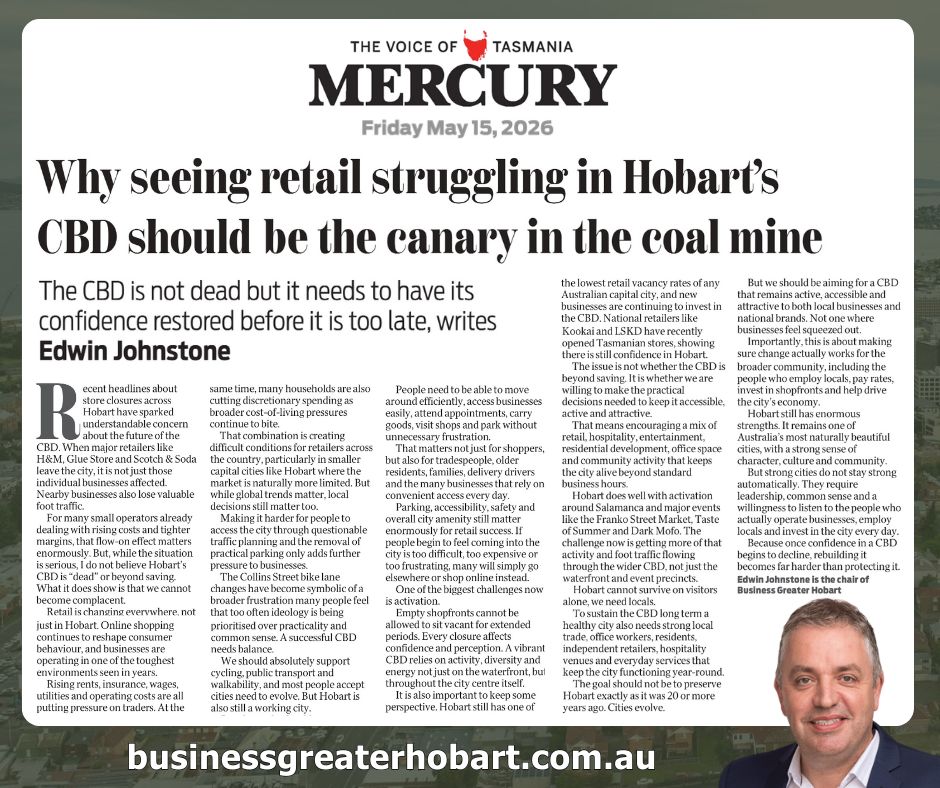
Recent headlines about store closures across Hobart have sparked understandable concern about the future of the CBD.
When major retailers like H&M, Glue Store and Scotch & Soda leave the city, it is not just those individual businesses affected. Nearby cafes, retailers and service businesses also lose valuable foot traffic.
For many small operators already dealing with rising costs and tighter margins, that flow-on effect matters enormously. But while the situation is serious, I do not believe Hobart’s CBD is “dead” or beyond saving. What it does show is that we cannot become complacent.
Retail is changing everywhere, not just in Hobart. Online shopping continues to reshape consumer behaviour, and businesses are operating in one of the toughest environments seen in years.
Rising rents, insurance, wages, utilities and operating costs are all putting pressure on traders. At the same time, many households are also cutting discretionary spending as broader cost-of-living pressures continue to bite.
That combination is creating difficult conditions for retailers across the country, particularly in smaller capital cities like Hobart where the market is naturally more limited. But while global trends matter, local decisions still matter too.
Making it harder for people to access the city through questionable traffic planning and the removal of practical parking only adds further pressure to businesses already doing it tough.
The Collins Street bike lane changes have become symbolic of a broader frustration many people feel that too often ideology is being prioritised over practicality and common sense. A successful CBD needs balance.
We should absolutely support cycling, public transport and walkability, and most people accept cities need to evolve. But Hobart is also still a working city.
People need to be able to move around efficiently, access businesses easily, attend appointments, carry goods, visit shops and park without unnecessary frustration.
That matters not just for shoppers, but also for tradespeople, older residents, families, delivery drivers and the many businesses that rely on convenient access every day.
Parking, accessibility, safety and overall city amenity still matter enormously for retail success. If people begin to feel coming into the city is too difficult, too expensive or too frustrating, many will simply go elsewhere or shop online instead.
One of the biggest challenges now is activation.
Empty shopfronts cannot be allowed to sit vacant for extended periods. Every closure affects confidence and perception. A vibrant CBD relies on activity, diversity and energy not just on the waterfront, but throughout the city centre itself.
It is also important to keep some perspective. Hobart still has one of the lowest retail vacancy rates of any Australian capital city, and new businesses are continuing to invest in the CBD. National retailers like Kookai and LSKD have recently opened Tasmanian stores in the city, showing there is still confidence in Hobart’s future.
The issue is not whether the CBD is beyond saving. It is whether we are willing to make the practical decisions needed to keep it accessible, active and attractive in the years ahead.
That means encouraging a mix of retail, hospitality, entertainment, residential development, office space and community activity that keeps the city alive beyond standard business hours.
Hobart does well with activation around Salamanca and major events like the Franko Street Market, Taste of Summer and Dark MOFO. The challenge now is getting more of that activity and foot traffic flowing through the wider CBD, not just the waterfront and event precincts.
Hobart cannot survive on visitors alone, we need locals who want to spend time there regularly.
To sustain the CBD long term a healthy city also needs strong local trade, office workers, residents, independent retailers, hospitality venues and everyday services that keep the city functioning year-round.
The goal should not be to preserve Hobart exactly as it was 20 or more years ago. Cities evolve. Retail changes. Consumer habits shift.
But we should be aiming for a CBD that remains active, accessible and attractive to both local businesses and national brands.
A city that feels welcoming, practical and full of life, not one where businesses feel increasingly squeezed out by rising costs, difficult access and uncertainty about the future direction of the city.
Importantly, this is not about being anti-change. It is about making sure change actually works for the broader community, including the people who employ locals, pay rates, invest in shopfronts and help drive the city’s economy.
Hobart still has enormous strengths. It remains one of Australia’s most naturally beautiful cities, with a strong sense of character, culture and community. It has a passionate small business sector, a growing tourism industry and a lifestyle many cities would envy.
But strong cities do not stay strong automatically.
They require leadership, common sense and a willingness to listen to the people who actually operate businesses, employ locals and invest in the city every day.
Because once confidence in a CBD begins to decline, rebuilding it becomes far harder than protecting it in the first place.
Edwin Johnstone
Chair, Business Greater Hobart